AI Overviews in brand searches: how to audit them
Translated from the Spanish original. Leer en español
AI Overviews already appear in most brand searches and Google builds them with third-party sources. How to audit what they say about your company.
In brief
- DemandSphere measured that AI Overviews on brand keywords went from 26.12% to 82.06% during September 2026, and Slate found one for 93 out of 100 brands.
- Only 29% of the 652 citations Slate collected pointed to the brand's own websites. The rest were external sources.
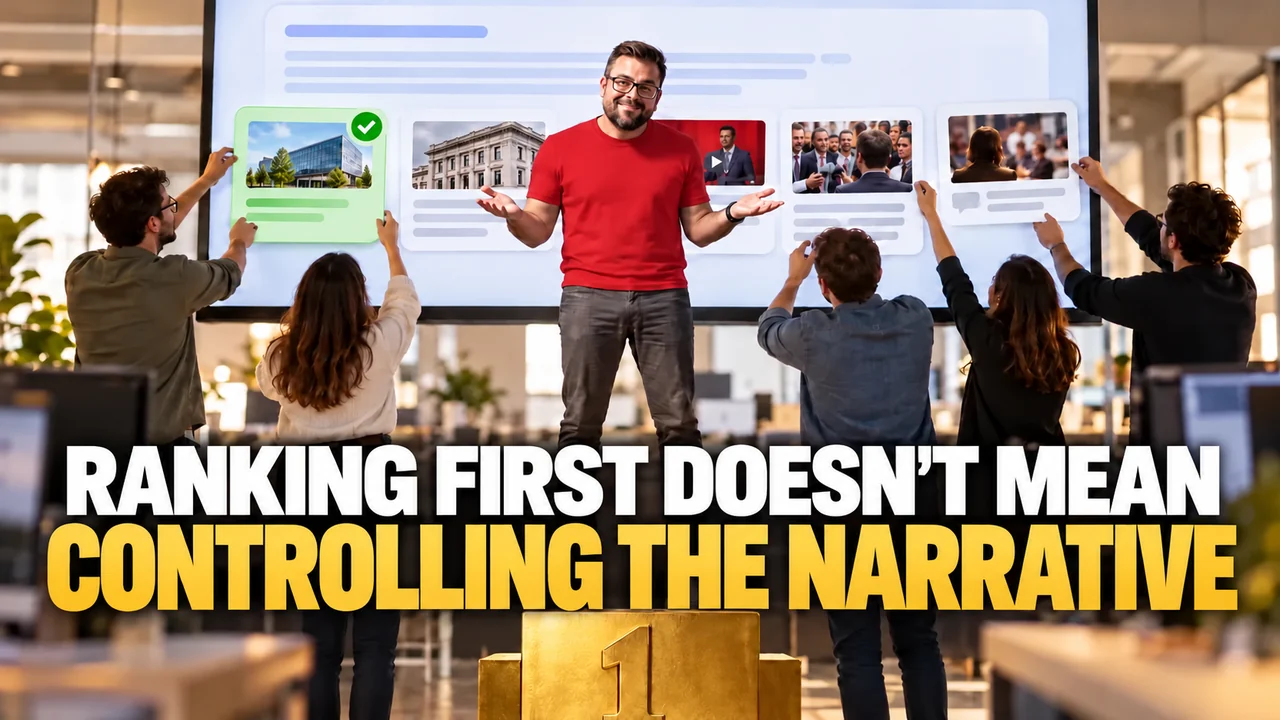
- Being the first result for your brand no longer equals controlling how Google explains it.
- What needs auditing are the claims (price, conditions, reputation...) and where each one comes from, not just the position.
What has changed in brand searches
Until recently, searching a company's name was the most comfortable part of SEO. Barring a reputational fire, the official website appeared at the top, some social profiles and, with luck, Wikipedia. The user already knew who they were looking for; they only had to find it.
Two analyses published on October 1 indicate this is changing: Google shows AI Overviews in many more brand searches. The easy news is "there are more AI Overviews". The interesting one is another: when someone types your name, Google can build an explanation of who you are with sources you don't control. Brand SEO becomes, in part, a sources problem.
What the data says, and what it doesn't
DemandSphere: daily series for September
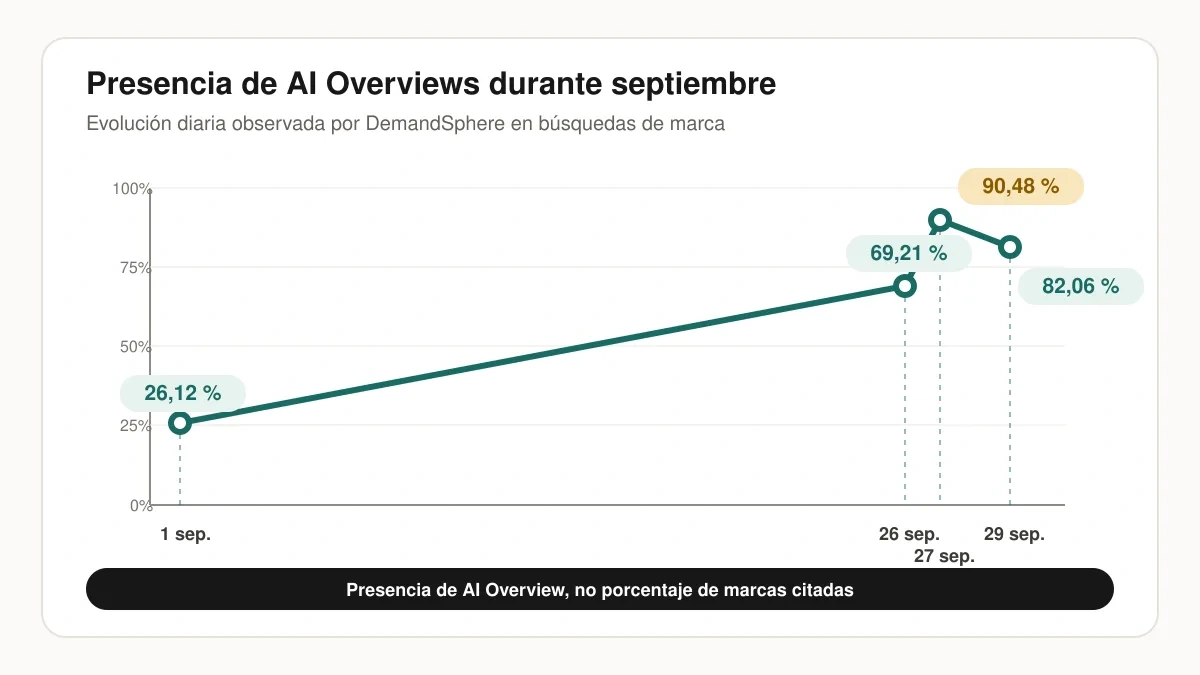
DemandSphere measured brand keywords every day during September. The presence of AI Overviews shot up at the end of the month:
| Day of September | Brand keywords with AI Overview |
|---|---|
| 1 | 26.12% |
| 26 | 69.21% |
| 27 | 90.48% |
| 29 | 82.06% |
If you cannot see all the columns, scroll the table sideways.
It should be read carefully. This first publication mixes markets and devices, and counts that an AI Overview exists, not that the brand is cited within it. In addition, Google hasn't officially announced any specific change for brand searches.
Slate: 100 brands searched in the United States
Between September 30 and October 1, Slate searched 100 brands. It found AI Overviews for 82 in the first run and for 93 after repeating some queries. Of the 44 queries it repeated, 16 changed between showing or not showing an AI Overview, so an isolated screenshot can mislead.
The most useful part of the study isn't the 93%, but where the information came from: only 29% of the 652 citations pointed to websites owned by the brand. The rest came from media, YouTube, Wikipedia, Shopping, Maps, social networks, retailers, forums, blogs and other external sources.
Two studies with different samples, markets and methods don't make a universal law. They do allow a cautious conclusion: there is recent evidence that brand searches are ceasing to be a space dominated only by navigational results.
Position 1 is not the same as controlling the narrative
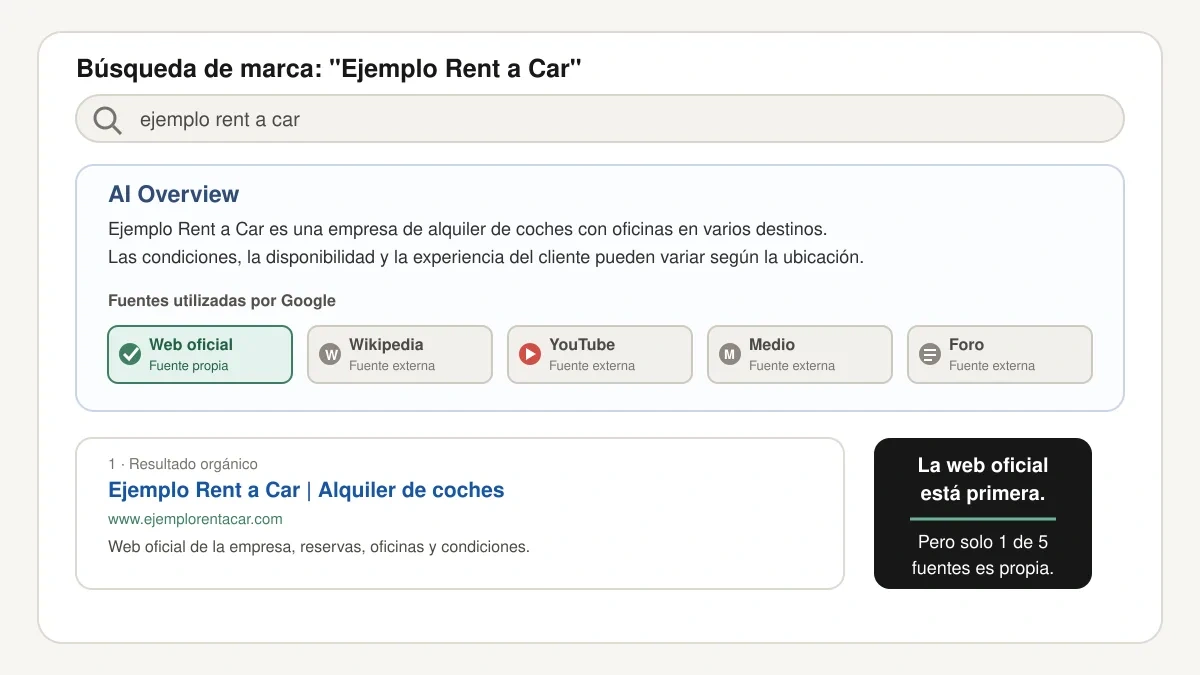
You can be the first result for your own brand and not control the first explanation the user receives. Think of a car rental company: its official website can hold position 1 while the AI Overview explains prices, conditions, fuel policy, deposits or reputation with third-party information.
The question is no longer just "are we first for our brand?". Now you have to add another: what is Google saying about us and where does it get it from? A brand search can have a perfect position 1 and, at the same time, a brand representation built with old, incomplete or third-party information.
It is not the same as GEO
In Being cited doesn't mean being recommended we saw the difference between being cited and being recommended in generative answers, where the user looks for options. And in why your competitors appear more than you in AI we saw the role of third-party sources.
Here the scenario changes: the user has already chosen the entity and types the brand name. The risk isn't being left out of a list of recommendations, but that Google explains your brand with a set of sources you only partly control. Your brand SERP looks less and less like a list of links and more like an editorial card built on the fly.
How to audit your brand searches, step by step
You don't need to create a new department or buy a tool with "AI" in the name. It is about extending the brand audit you should already be doing.
- Choose 20-30 brand queries with real intent. Combine the brand name with: reviews, prices, contact, cancellation, refund, deposit, problem and alternative. The combinations depend on the business: a SaaS, a hotel, an airline or a car rental company need different lists.
- Check them several times over seven days, noting country, device and date.
- Save the AI Overview text and all its sources.
- Classify each important claim by topic and by source (table below).
- Mark whatever is incorrect, old, ambiguous or backed only by third parties.
- Check whether there is a clear, crawlable and up-to-date official page that answers that claim better.
The useful unit of measurement isn't "appears / doesn't appear", but the frequency of appearance over a period and the stability of the sources.
The source map matters more than the citation counter
Suppose your brand appears cited in its own AI Overview. Good. Now suppose Google uses your website to explain what you do, but a 2023 forum to explain your cancellation policy. The own-citation percentage would look acceptable and the result would still be a problem.
That is why it is worth classifying sources by claim, not just by domain:
| Topic | Question you must answer |
|---|---|
| Identity and product | Who tells Google what the company does? |
| Price | Who tells Google how much it costs? |
| Conditions and policies | Which source do cancellations, refunds or deposits come from? |
| Availability | Is the information about offices, hours or stock current? |
| Reputation | Which reviews does Google use and from what date are they? |
| Support | Which contact or help channels does it mention? |
| Incidents or controversies | Which problems does it highlight and with which sources? |
If you cannot see all the columns, scroll the table sideways.
That is where problems appear that a traditional rank tracker doesn't see.
Application in travel and car rental
In travel this is especially uncomfortable because a lot of information changes: hours, locations, fees, deposits, fuel conditions, age policy, cancellations, luggage, availability or payment requirements can vary by market, office or provider. If the official information is hard to find, is spread across PDFs, old pages and help centers, or contradicts what third parties publish, Google has more reasons to resolve the answer with other sources.
For a car rental comparison site I would separate two groups of searches:
- The comparison site's brand: what Google says about the service itself, how it works, what it compares, its policies and its reputation.
- Provider brands: which sources Google uses when the user searches for a specific company and how prices, offices, deposits, conditions and reviews appear.
This can reveal something valuable: pages that rank well for generic searches but aren't the best source to explain concrete facts about the entity.
What goal to set
I wouldn't try to "optimize for the AI Overview" as an abstract goal. I would try to make sure the important facts about the brand have an official source better than any alternative. It is less showy, but much more actionable.
Frequently asked questions
What is an AI Overview in a brand search?
It is the AI-generated answer block Google can show when someone types a company's name. It is built with sources both from and external to the brand.
How many brand searches show AI Overviews?
It depends on the study. DemandSphere saw the presence go from 26.12% to 82.06% during September 2026, and Slate found AI Overviews for 93 out of 100 brands after repeating some queries. The samples and methods are different and Google hasn't announced a specific change, so it isn't a universal figure.
Can I control what Google says about my brand?
Not all sources: only 29% of the citations in Slate's study pointed to the brand's own websites. You can, however, make sure that, when Google looks for an answer about your company, the official source is clear, accessible, current and hard to beat.
To finish your coffee
Brand search was always a safe zone of SEO: people already knew who you were. If AI Overviews keep entering that territory, that safety diminishes. The work no longer ends by checking that you hold the first position; you have to check who tells each part of the story.
If you want to review how Google explains your brand, tell me your case. And if you also want your content to be easier to cite, download the writing guide for AI visibility (in Spanish).
Sources and further reading
DemandSphere. "AI Overviews on branded queries tripled in September", October 1, 2026. - https://www.demandsphere.com/blog/branded-ai-overviews-september-2026/
Slate Research. "What Google's AI Overviews Say About Your Brand: 100 Brand Searches Analyzed", October 1, 2026. - https://slatehq.com/blog/ai-overviews-brand-searches
Google Search Central. "Introducing Search Generative AI performance reports in Search Console". - https://developers.google.com/search/blog/2026/06/gen-ai-performance-reports
Google Search Central. Preferred Sources. - https://developers.google.com/search/docs/appearance/preferred-sources
Search Engine Land. "Google AI Overviews jump from 26% to 80% of branded queries", October 1, 2026. - https://searchengineland.com/google-ai-overviews-jump-branded-queries