Competitors in ChatGPT and Gemini: research their sources
Translated from the Spanish original. Leer en español

AI assistants also rely on what others publish about your brand. How to research the sources, mentions and backlinks of your competitors.
In brief
- Generative assistants don't build their answers only from what a company says about itself: when they use web search, they can rely on information published by third parties.
- The exact formula that decides which brand appears isn't known, and you can't claim that getting certain links will make ChatGPT or Gemini mention you.
- What you can do is research: which brands appear, which sources are used and which websites repeatedly surround your competitors.
- Mention and source are different things and are worth measuring separately; crossing them with a backlink gap gives clues, not causation.
Why looking only at the competitor's website falls short
When a brand shows up again and again in answers from ChatGPT, Gemini, Perplexity or in Google's generative summaries, the easy explanation is that it has a better optimized website, more authority or a superior content strategy. It may be. But there is another part we tend to look at much less: who talks about that brand outside its domain.
When analyzing a rival we usually go straight to its website: what content it publishes, how it structures pages, which keywords it works, what authority it has, how many links it receives or what structured data it uses. All of that is necessary. The problem appears when we treat the website as if it existed in isolation from the rest of the Internet.
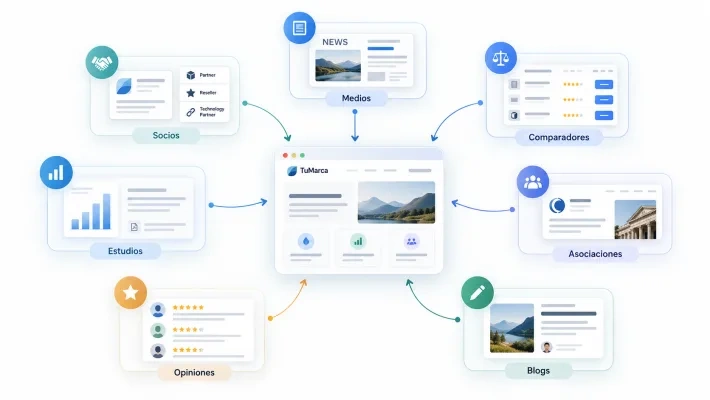
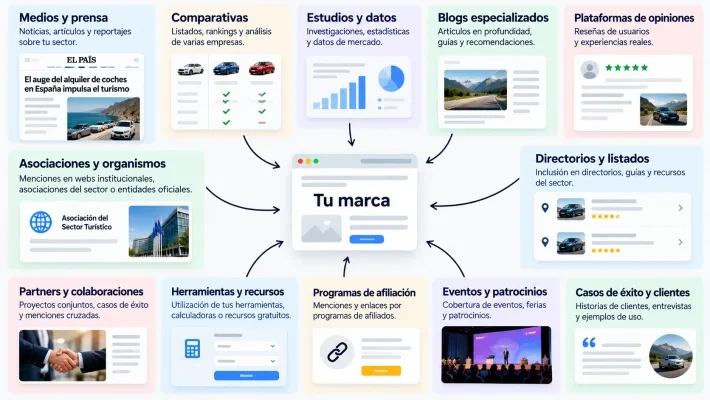
A company can publish the best page in the sector explaining why its service is fantastic and still be the company talking about itself. Things change when there are media outlets that use its data, comparison sites that include it, associations that mention it, specialized blogs that recommend it or independent publications that use it as a reference. Specialized media, comparison sites, blogs, associations, studies, review platforms, partners, relevant directories: all of that forms a network around a company.
From a GEO research point of view, that difference deserves attention. Not because an external mention guarantees appearing in a generative answer, but because it helps understand how that entity is represented outside its own domain. If you are interested in the other side, how to write to get cited, you have it in how to write so AI cites your website or mentions your brand.

What we don't know and what we can do
We don't know the exact formula that determines why one brand appears in an answer and another doesn't. Nor can we claim that getting certain links will make ChatGPT or Gemini start mentioning us.
What we can do is observe which brands appear, which sources the assistants use, which websites talk repeatedly about our competitors and which patterns repeat. The question changes: instead of "how do I get to appear in ChatGPT?", we research what ecosystem of sources exists around the brands that already appear. Good old reverse engineering.
First step: check who appears and with which sources
Before analyzing links or opening Semrush you have to know what really happens in generative answers. For that you prepare a reasonable set of questions from our market. No strange prompts or queries designed to force an answer: the questions a normal user would ask are what matter. You can mix generic questions about a category, comparisons, doubts about conditions, features and specific problems, as well as searches in which brands appear.
For each query it is worth noting which brands appear, in what position within the answer, which sources are shown when the system offers them and under what conditions the test was done. And save the date: generative answers can vary between users, sessions and moments, so a test is a snapshot, not a permanent ranking. If a brand appears once in ChatGPT we know very little; if it appears repeatedly across different questions, there starts to be a pattern worth studying.
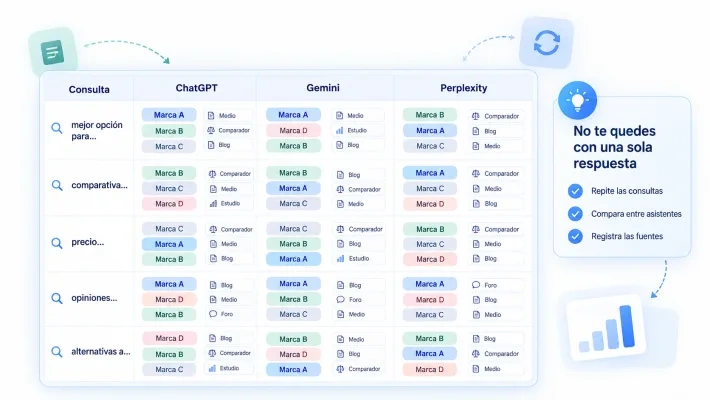
Then comes the most interesting question: where does the information come from? Some assistants show links or references when they use information obtained from the web; others show sources in another way or don't show them in every answer. When possible, you have to record them, and not just the page: also the domain and the type of source (a company website, review platform, specialized media outlet, comparison, institutional website, guide, study or publication that uses data from several companies). After several queries we will see which domains repeat. That doesn't prove by itself that a source has special weight within the system, but it does give us something very valuable: places worth researching.
Mention and source: two different signals
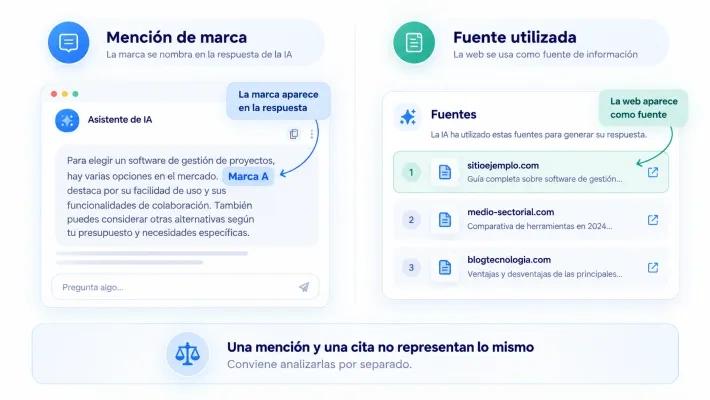
It is easy to mix them up. A company can appear mentioned in an answer without its website being among the sources, and the other way around: a page can come out as a reference used even though the brand that publishes it isn't mentioned in the answer.
| What we measure | What it tells us | What we lose if we look only at it |
|---|---|---|
| Mentions | Which brands (ours or the competitors') achieve visible presence for the user | Information about the pages that feed the answers |
| Sources | Which websites appear as a reference in the answers | Which brands achieve visible presence |
If you cannot see all the columns, scroll the table sideways.
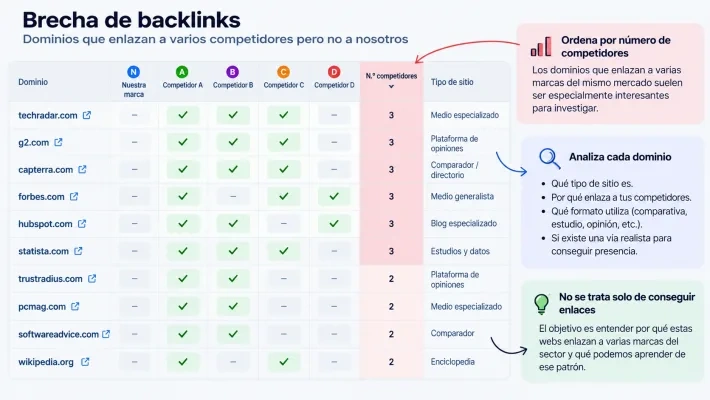
Second step: use the backlink gap as a map
With the first snapshot of generative visibility done, another layer is added: a backlink gap, which shows which domains link to several competitors but not to us. Semrush, Ahrefs and other tools offer it; the specific tool isn't what matters. We aren't looking for a huge list of sites where we can try to get links either, but to answer another question: which websites appear repeatedly around the brands we are researching?
If a domain links to a single competitor, it can be due to hundreds of reasons. If that same publication links to four relevant companies in the sector, it already deserves attention: maybe it is a specialized outlet that analyzes that market regularly, a comparison, an affiliate, an association, a publication that uses external studies or a website with commercial relationships with several companies in the sector. What matters is the repetition. That is why, before sorting the list by authority, it is worth sorting it by number of competitors present: the domains that surround several brands are the first candidates.
Third step: open the pages and understand why the links exist
Finding a recurring domain is only the beginning. A tool can tell us that a publication has twenty links to a certain competitor, but that doesn't explain why they exist. You have to check. The possible causes:
- The competitor provided data for an article.
- It is part of a comparison.
- There is an affiliate relationship.
- There is a collaboration with an association.
- It is a free tool that other sites recommend.
- It is a press release, a sponsored campaign or a link automatically repeated across hundreds of pages.
Each case tells a different story, and that context is much more useful than the isolated backlink, because the goal isn't to copy a link but to understand what made that company achieve presence in that source. If several competitors appear because they publish their own statistics, there is one possible strategy. If it is because of an affiliate program, there is another. If an outlet regularly uses external studies to build its articles, there is also something workable. The backlink is the visible footprint; what is interesting is finding out what produced it.
Fourth step: cross the two investigations without jumping to conclusions
Now there are two maps: the sources found in generative answers and the domains that appear repeatedly around several competitors. Time to look for coincidences. Suppose a specialized publication links to three competitors and also appears as a source when we ask different assistants about questions in the sector. That doesn't prove its backlinks are responsible for the brands appearing in those answers; that would be too big a logical leap. What we have is something more modest, but more useful: a coincidence of signals.
Maybe it is a habitual reference in the sector, maybe it produces especially useful information, maybe it has very deep topical coverage, or there may be a completely different explanation. The correct conclusion isn't "we need a backlink from that website", but "we need to understand why that website appears so much inside this ecosystem". That difference avoids turning GEO into an absurd race to get links from any domain an AI cites.
Not every source is an opportunity
There will be important sources where probably nothing can be done: official bodies, big platforms, databases, closed media or websites that publish exclusively their own information. They aren't irrelevant, because they help understand where the sector's information comes from, but an important source isn't necessarily an opportunity. A smaller specialized publication can offer a real collaboration, accept data, take part in a study or appear in a comparison; a gigantic domain can be much more visible and offer no reasonable route. That is why authority shouldn't be the only criterion: topical relevance and the real possibility of taking part matter more than an isolated metric reflects.
How to apply it: from the spreadsheet to the task
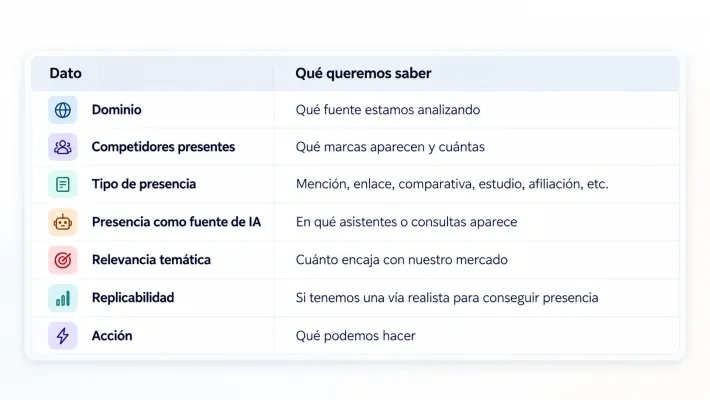
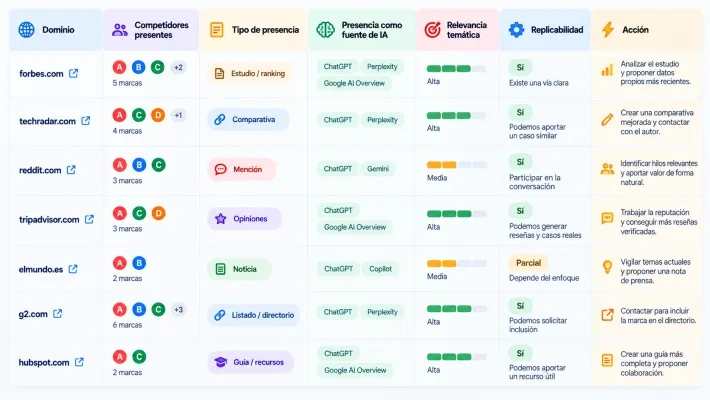
A research like this easily ends in a huge sheet full of domains, metrics and colors. It is no use if it doesn't generate concrete work. The final table can be simple, and the last column is the one that turns the analysis into strategy.
- Define the questions of a normal user in your market: generic, comparisons, conditions, features and specific problems.
- Test them in several assistants and note brands, position, sources shown, test conditions and date.
- Record domain and type of source and measure mentions and sources separately.
- Do the backlink gap and sort the domains by number of competitors present, not only by authority.
- Open the pages and find out why each competitor appears.
- Cross both maps, separate important sources from real opportunities and write one concrete action for each pattern.
"Get a link" isn't an action; "prepare a study with our own data because this publication uses statistics from three competitors" is. Nor is "appear in this comparison" enough, whereas "analyze how they select companies, check whether we meet the requirements and contact the editor in charge" is already a task. The difference seems small, but it avoids ending up with another list of opportunities nobody executes.
| Finding | Concrete action |
|---|---|
| Several competitors appear because they publish their own statistics | Prepare a study with our own data |
| A publication uses statistics from three competitors | Prepare a study with our own data for that publication |
| A comparison includes several competitors | Analyze how they select companies, check whether we meet the requirements and contact the editor in charge |
| Competitors appear through an affiliate program | Assess that route as a separate strategy |
| An outlet regularly uses external studies | Work that route by providing our own information |
If you cannot see all the columns, scroll the table sideways.
What this method doesn't prove
Finding a relationship between backlinks, external sources and presence in generative answers doesn't prove causation. A brand can appear because it has notoriety, because there is abundant information about it, because the query favors certain results or because of factors we can't observe. Also, ChatGPT, Gemini, Perplexity and Google don't necessarily use the same sources nor build their answers with the same systems. It is a way to research patterns, not a formula to "rank in AI".
The good news is that you don't need to know the whole algorithm to learn useful things. In SEO we have been working this way for decades: we observe, compare, form hypotheses, test, measure and discard what doesn't work.
What we are really researching
More than a backlink audit, we are rebuilding a market's information ecosystem: which media outlets appear, which comparison sites take part, which sites use external data, which associations have presence, which platforms repeat, which companies are cited, which pages appear as a source and what type of content manages to circulate outside the brands' own websites. Links are part of that ecosystem, but they aren't the only element: there are also mentions without links, studies, statistics, comparisons, reviews, public relations, associations, tools and collaborations.
That changes the GEO approach. It isn't only about what to publish on your website so an AI understands you better; you also have to look outside. If your competitors show up again and again in ChatGPT, Gemini or Perplexity, maybe the difference isn't only in what they say about themselves, but in who talks about them, where that information appears and which sources help build their presence outside their website.
Related: being cited doesn't mean being recommended and what happens when Google talks about your brand with third-party sources.
Frequently asked questions
Will a backlink from the website the AI cites make them mention me?
You can't claim that. Finding a relationship between backlinks, sources and presence in answers doesn't prove causation: the useful conclusion is understanding why that website appears so much in the ecosystem, not simply getting a link from it.
What is the difference between mention and source?
A brand can come out in the answer without its website being listed as a source, and a page can serve as a reference without the brand being mentioned. That is why they are measured separately.
How do I know which domains to research first?
Sort the backlink gap by number of competitors present before authority, and prioritize sources with topical relevance and a real route to take part.
To finish your coffee
If you want to research your market's ecosystem of sources, tell me your case. And to make your own content easier to cite, you have the GEO writing guide (in Spanish).