GEO Writing: how to get AI to cite or mention you
Translated from the Spanish original. Leer en español

How to write so an AI cites your website or mentions your brand: direct answers, data with a source and a checklist of nine questions to review.
In brief
- Citation and mention are different things: the first links your website as a source; the second puts your name in the answer, with or without a link. Record them in separate columns.
- From the writing side you control this: answering quickly and precisely, providing data you can prove, making clear who is speaking and dating the sources.
- There is no formula that ensures an AI will choose you; what there is is room to give it better reasons.
- The 13-page GEO guide suggests 40-60 words to open the answer. It is the guide's editorial criterion, not a Google rule.
Two ways of showing up in an AI answer
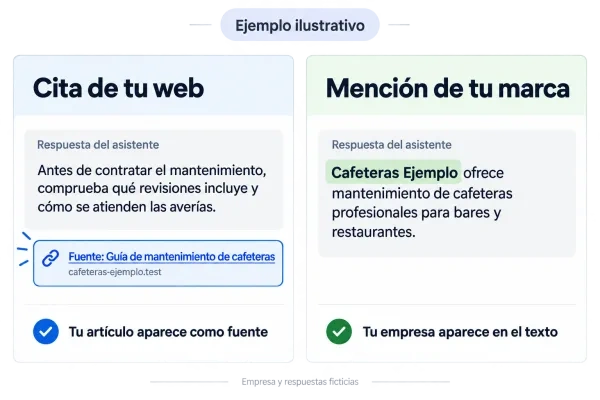
A potential customer puts to an AI the problem you solve. Your company can show up in two ways. If the AI points to you as the origin of the information, almost always through a link, we speak of a citation. If what appears is your brand's name within the text, with or without a link to your page, we speak of a mention.
They don't necessarily go together. Imagine an assistant that links your pricing study but doesn't name you, or that names you and, instead, links a comparison written by another company. Besides, being cited is not the same as being recommended. We developed that distinction in Citing you doesn't mean recommending you.
The discipline that pursues that presence is called GEO (Generative Engine Optimization). According to OpenAI, ChatGPT Search can answer with data drawn from the web and accompany it with links to the sources. Being one of those references is what we try to make easier when we edit a text.
Along those lines, Aggarwal and his team published at KDD 2024 a paper on which changes to a piece of content can increase its visibility. In their tests, adding sources, statistics and relevant quotes worked, with an effect that varied by topic. Useful as an editorial compass, but limited to the systems and experiments of its authors: nothing ensures a specific tweak will produce a mention in today's systems.
How to support your brand in the text
Put your company's name where it is the one providing the data, the proof or the service, and detail what it did, what it sells and under what conditions. That way the information can be attributed correctly. Dropping the brand without backing doesn't do the same.
For an analysis of your own you can use this skeleton: "[Company name] analyzed [number of cases] between [dates] to check [study question]. The result was [verified figure], calculated using [method]". The brackets are gaps you must fill in with real information.
Describing a service requires the same concreteness: what you do and for whom. "We repair professional coffee machines for bars and restaurants in [municipality]" informs; "we offer comprehensive quality solutions" says nothing.
All this concerns what depends on your pages. Mentions are also born on other people's websites, as in the case of the third-party comparison, and there why your competitors appear more than you in ChatGPT, Gemini and Perplexity comes into play.
Writing the paragraph someone could cite
Think of a snippet that works on its own: you know what it is about, it answers a precise question and it carries something verifiable. Start with the answer and leave the nuances, the date or the source for afterwards.
An example. With the heading "Do I need an llms.txt file to appear in Google's AI answers?", this opening says nothing:
With the advance of artificial intelligence, new tools and files have emerged that are worth knowing to improve our digital presence.
Compare this alternative, which answers in the very first line:
Google doesn't require an llms.txt file to appear in its AI search results. According to its documentation, Google Search ignores those files, so including them neither adds nor subtracts visibility on Google.
The second option names the platform and lets anyone verify what is said. And watch the "on Google": the source doesn't allow generalizing to other AI services.
The guide you can download uses car rental cases to show the jump from a generic paragraph to a concrete one. The figures it uses are fictitious and flagged as such; they are there only to show how to present data.
What to offer so that citing you is worth it
Your own data, documented tests, comparisons of conditions and answers to what your customers ask again and again all work. Each piece of data needs its source and its context: what you measured, for how long and how.
An average price taken from your bookings, for example, calls for stating the period analyzed, the number of bookings included and whether the amount includes taxes or extras. Without that, nobody can judge it or compare it with others.
If you use someone else's information, put the link to the original source right next to the claim. Like this: "The GEO study presented at KDD 2024 used a test bench of 10,000 queries to evaluate visibility strategies", something that can be verified in Aggarwal and collaborators' research paper.
No statistics of your own yet? You still have a documented test, a comparison of conditions or a real case told by whoever lived it. Use what you have and make clear how far its conclusions go.
And a warning: Google warns that mass-producing AI pages with no value for the user can violate its policies against scaled content abuse. Before the next article, consider what the reader will take away that really serves them.
How to apply it: structure and pre-publication review
This is the organization the GEO guide recommends. They are editing guidelines, with no magic word count and no obligation to turn every heading into a question.
| Element | What to do |
|---|---|
| Concrete title | Anticipate which question will be solved and in what context. |
| Answer at the start | Conditions, exceptions and examples come afterwards. |
| Sections with real questions | If the question is the price, open with the price and detail what it covers. |
| Data and sources | A table to compare conditions; a link to verify a claim. |
| Experience and review date | Who tested, analyzed or reviewed it, and when. |
If you cannot see all the columns, scroll the table sideways.
Frequently asked questions only if something is still unanswered; if you have already solved it in the text, ask yourself whether they would add anything. In its documentation on generative search, Google clarifies that it doesn't ask you to chop content into small pieces or write in a special way for its AI systems. If a template spoils the reading, adapt it.
And before publishing, go over these nine checks, adapted from the guide's checklist:
- Does the title make clear what the article is about?
- Is the main answer found right away?
- Does each section solve the question its heading raises?
- Is it clear what we are talking about when reading the main paragraphs separately?
- Do the important claims have a source or an explanation backing them?
- Do our own data indicate how they were obtained and which period they correspond to?
- Do we provide any data, example or experience that justifies using our article as a source?
- Is it clear what information our company provides and what services it offers, when relevant to the question?
- Have we reviewed the conditions, the dates and the links?
A quick exercise: take three paragraphs from an article of yours, pull them out of the text and see whether they still explain on their own what they are about. A colleague as a reader will soon point out where context is missing. This test detects lack of clarity; it doesn't predict whether an AI will cite you.
Plan for today
- Pick a question a potential customer would ask an AI before hiring you.
- Find the article on your website that best answers it and check what useful thing it contributes and whether it is clear when the information comes from your company.
- Touch it up with the checklist.
- Note whether it shows up for that question in the assistant you want to watch: answer, date and links. With a single test you can't judge the evolution.
Don't forget the technical side: according to Google, to be eligible for its generative results the page has to be indexed and able to be shown with a snippet in Search. Writing well is one more piece, along with the requirements and best practices. For the big picture, Google, SEO and AI: what is changing.
Frequently asked questions
How long should the initial answer be?
The guide suggests 40 to 60 words, as an editing criterion. Google doesn't set an ideal length for its AI searches, so adjust it to what you need to say.
What if I don't have statistics of my own?
Turn to a documented test, a comparison with sources or a real case, explaining who did it, what they checked and under what conditions so the reader can decide whether it is valid for them.
Does meeting the checklist ensure an AI cites me?
No. It serves to evaluate editorial quality, not to guarantee a citation. To measure results, separate brand mentions, links to your website and visits, and note in each check the question, the platform and the date.
To finish your coffee
The goal is that, if someone asks about something your company masters or solves, your content has reasons to get into the answer. Start with one article: a concrete question, a useful answer and proof you can show.
If you prefer to review your content with company, tell me your case. And to have the criteria at hand, in Downloads you have the free writing guide for AI visibility (GEO) (in Spanish): 13 pages with guidelines, before-and-after examples and the checklist.