ChatGPT Ads versus Google Ads: what the study says
Translated from the Spanish original. Leer en español
An analysis of 1,898 online stores raises an uncomfortable question: can ChatGPT become a major advertising channel when its paid clicks generate fewer sales than Google? The data also leaves an important clue for SEO: advertising can take away organic traffic, but it does not appear to have sunk its conversion.
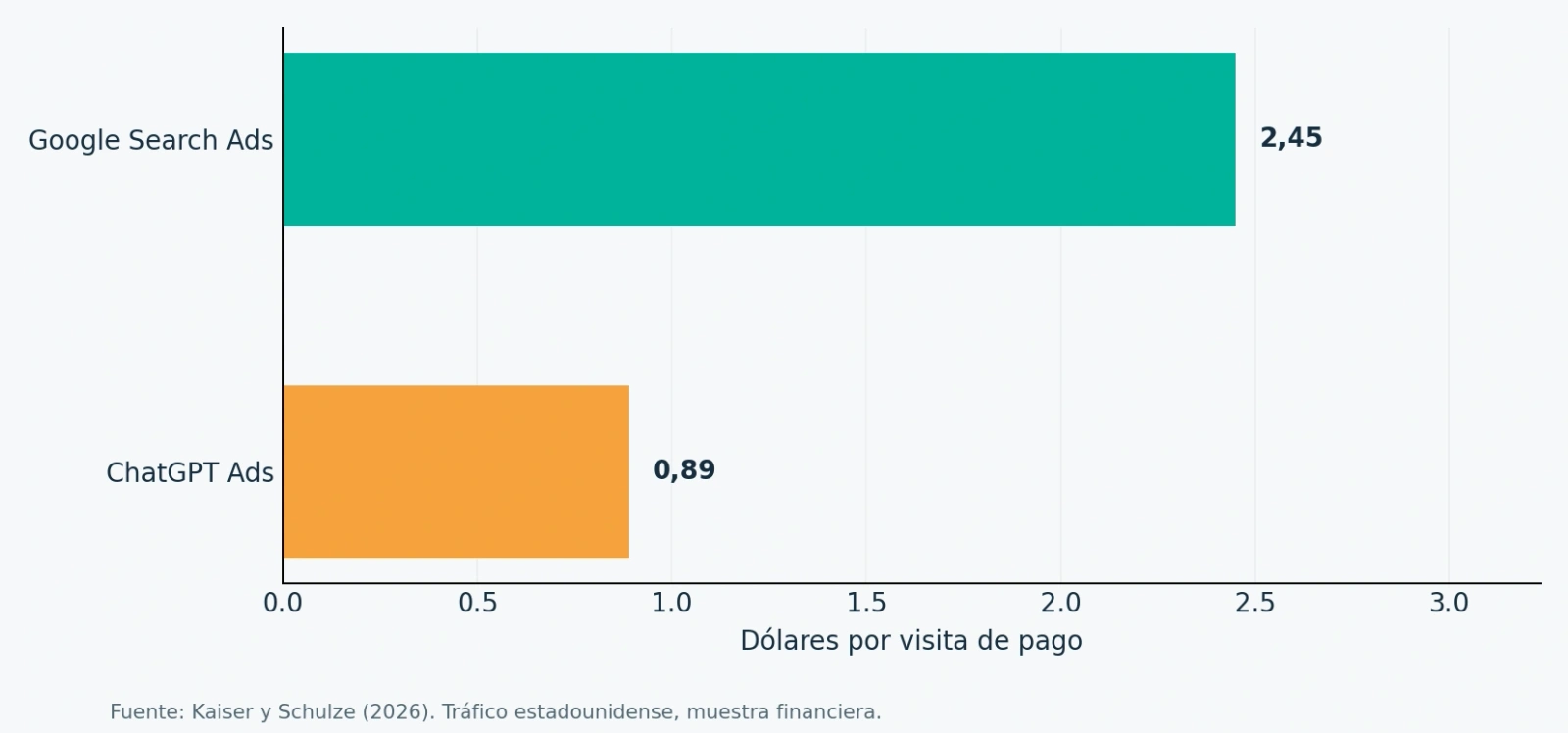
In the study's US traffic, each visit from ChatGPT ads produced $0.89 in revenue versus $2.45 from Google Search Ads: 64% less.
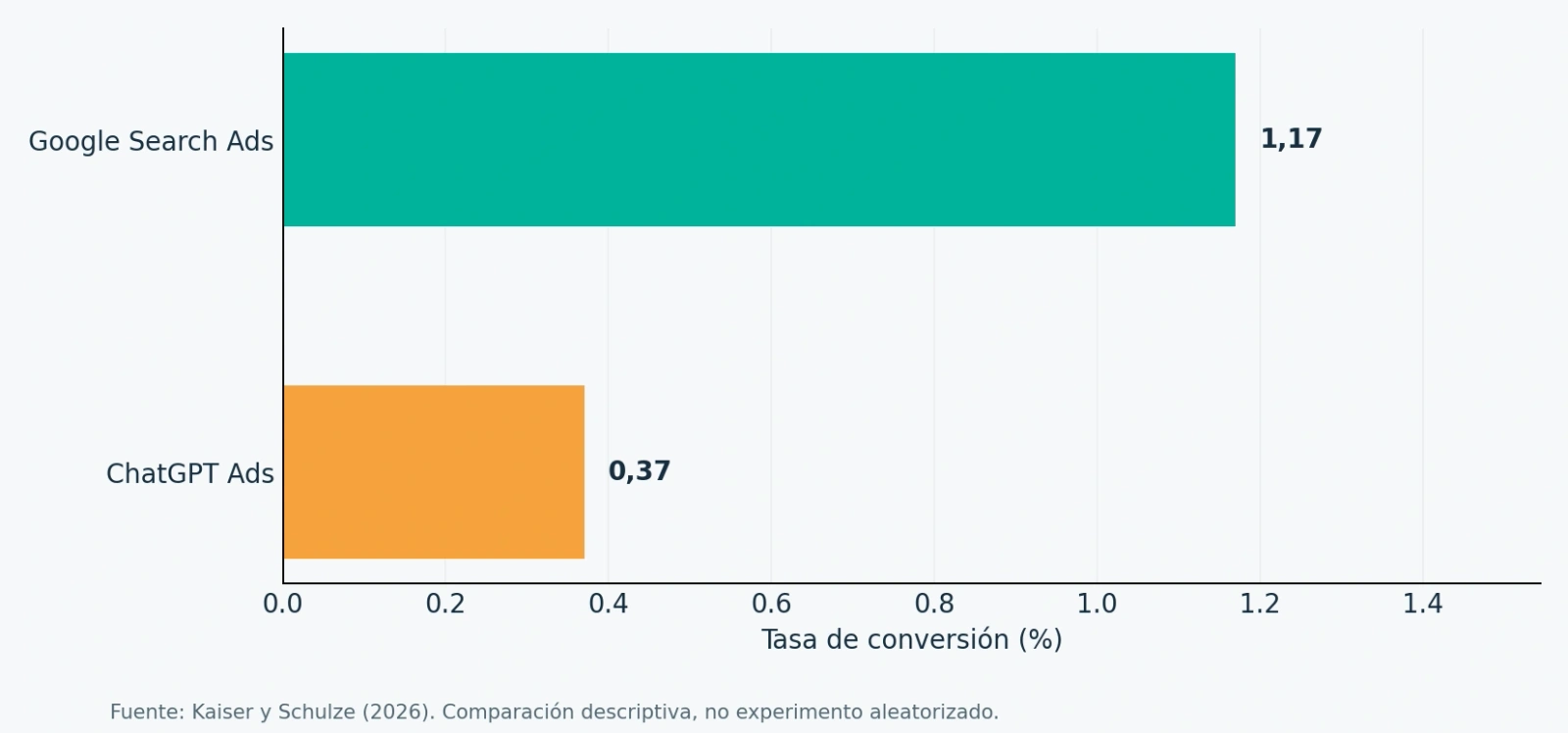
Conversion was 0.37% versus 1.17%. On top of buying less often, the order value was lower in the adjusted comparison within the same stores, not in the aggregate average.
84% of the 87 advertisers that bought both channels in the United States recorded no purchase attributed to ChatGPT Ads. That is not the same as claiming they never sold later through other channels.
After ads were introduced, organic traffic referred by ChatGPT showed an estimated drop of 5.9%. Adjustments for regional growth take the estimate to 7.2%-8.4%, depending on the assumptions.
The conversion of referred organic traffic barely changed. The useful reading is not "AI doesn't sell", but that organic recommendation and sponsored click must be measured separately.
What does the study examine and what sample does it refer to?
There is a very human temptation when a new advertising channel appears: try it before the competition, announce that we are already there and show off some great screenshots in the marketing meeting. Until someone asks how much it has sold.
A paper by Maximilian Kaiser, of the Vienna University of Economics and Business, and Christian Schulze, of the Frankfurt School of Finance & Management, makes it possible to ask precisely that question. Their study, "Can Advertising Fund Free AI? Evidence from ChatGPT's International Advertising Rollout", uses almost ten billion sessions recorded over 60 weeks, between June 2025 and August 2026. The organic panel brings together 1,898 online stores with aggregate annual sales of around $16 billion.
That sounds huge, but there is one precision that changes the reading: the advertising financial results come from 102 advertisers with complete data; 87 of them bought both ChatGPT Ads and Google Search Ads in US traffic. This is not 1,898 advertisers subjected to an A/B test.
The authors published the work in October 2026 as a working paper, still under review. It is serious evidence for forming hypotheses and making prudent decisions, not a universal verdict on any future campaign.
What does 64% less revenue mean?
The comparison is of attributed revenue per paid session, not of the platforms' global turnover. In the observed stores, a visit from ChatGPT Ads generated $0.89 on average; a visit from Google Search Ads, $2.45.
There are two reasons behind the difference. The first is that the user arriving from ChatGPT Ads buys less often. The second appears when comparing within the same stores and adjusting for device and week: the study estimates orders $74 lower on ChatGPT. That is not the aggregate average: that comparison, which mixes different advertisers, was $240 on ChatGPT versus $209 on Google Search. They are different measures and should not be confused.
This alone does not prove that the ChatGPT user has less commercial intent. The format, the ad placement, the selection of advertisers, the maturity of the campaigns, the type of query and the moment in the purchase journey can all play a role. The observed difference is real in this sample; the causal explanation is not settled.
What does it mean that 84% recorded no sale?
Here is the figure I would take to an investment meeting. Of the 87 advertisers that bought ChatGPT Ads and Google Search Ads in US traffic, 73 did not record a single transaction attributed to ChatGPT ads. Between them they accumulated 18,726 paid sessions. The 570 observed purchases belonged to the other 14 companies.
It is not correct to write that "84% of the companies advertising on ChatGPT don't sell". We are talking about a specific sample, an initial period and sales that can be linked to those visits. Last-click attribution leaves out later purchases, cross visits and part of the brand effect.
Even so, the authors checked whether it could just be a matter of low volume. When they applied to those visits the conversion rates each advertiser was getting on paid search, the expected number of advertisers without sales was much lower. The problem does not disappear by looking at the sample size.
From a marketing perspective, the practical consequence is immediate: don't confuse the availability of a new platform with proof that a profitable channel exists. A campaign can bring clicks, generate conversations in the team and still not contribute a single provable sale.

How much should a click on ChatGPT cost to compete with Google?
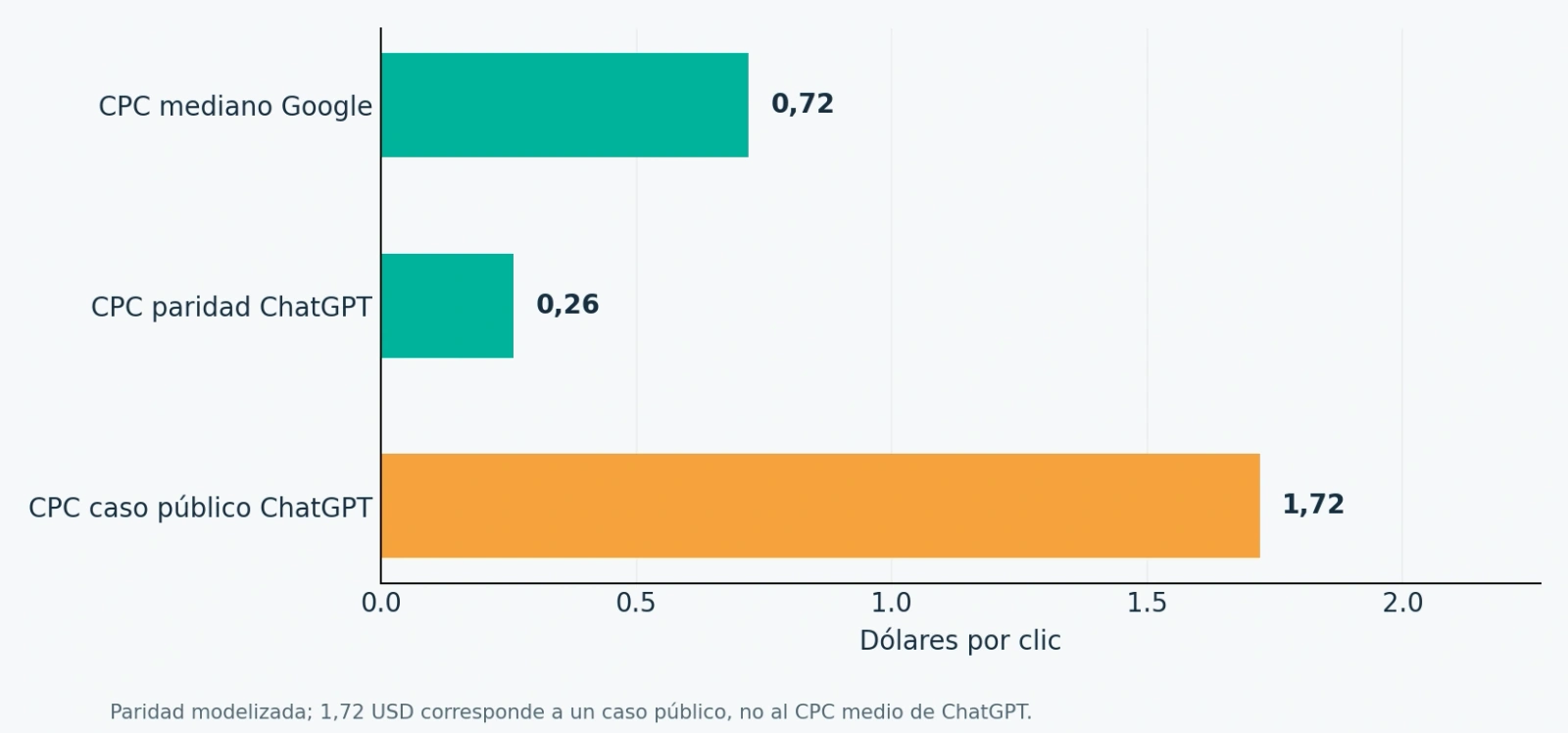
The authors used a group of advertisers with Google Ads cost data. The median search CPC was $0.72. Since ChatGPT's revenue per visit was considerably lower, they calculated that its click would have to cost roughly $0.26 to achieve the same return per dollar invested, keeping conditions comparable.
Against that reference there is a public ChatGPT Ads case with a CPC of $1.72. That is more than six times the estimated parity price. But it is not the market average price nor a universal rate: it is one publicly documented account, used by the researchers as a comparison.
There is a common trap with ROAS: assuming that the observed revenue tells the whole story. If ChatGPT influences a purchase that closes days later through direct traffic, the last-visit model will not assign it. That can undervalue the channel. The same can happen with Google. The right question is how much incremental effect one adds over the other, measured with an experiment or a controlled model.
What happened to organic traffic and its conversion?
The study takes advantage of the fact that advertising reached different countries on different dates. During the analysed period, the European Union acted as the ad-free comparison group. The model examines changes in organic referrals after each rollout, controlling for trends and other observable differences.
The base result is an estimated 5.9% reduction in organic session volume in the first 13 weeks, with a 95% confidence interval between -12.6% and +1.2%. Since it includes zero, it does not allow claiming a statistically proven drop with that model.
When the authors correct for a hypothesis of faster ChatGPT usage growth in North America, the estimated drop reaches between 7.2% and 8.4%, and then it is significant. The prudent conclusion is that there are signs of a moderate reduction in organic referrals when advertising is introduced, conditioned on the validity of the adjustments.
| Measure | Result | How to read it |
|---|---|---|
| Organic referrals, base model | -5.9% | Estimated drop; not conclusive at 95% |
| Model adjusted for regional growth | -7.2% to -8.4% | Significant under the applied assumptions |
| Organic conversion before ads | 2.21% | Reference before the rollout |
| Later change in conversion | -0.02 points | Not significant; stable performance |
If you cannot see all the columns, scroll the table sideways.
The conversion of organic traffic barely moved. This is the contrast that deserves attention: there are signs that the channel sends fewer clicks, but the people who still arrive keep a similar probability of buying.
It cannot be concluded that ads replaced organic results one by one, nor that users lost trust. The work does not observe the individual impression of each ad, the prompts or the choice of each recommendation. It measures aggregate changes across markets.
Why separate organic recommendation and ad?
On Google we know how to easily tell the sponsored block from the organic result. In a conversational assistant the user's relationship with the answer is different: they are requesting an explanation or a recommendation built for their situation. A separate ad may receive less attention. One too blended with the advice may call its neutrality into question.
The authors raise that dilemma drawing on other experiments about advertising integrated into answers. Their study of stores does not prove that ad integration automatically manipulates the user. What it raises is a difficult balance between commercial value and trust.
For SEO and generative visibility, separating channels is essential. A brand mention inside the answer, a citation with a link, an organic click, a visit from a product listing and a sponsored click are different events. Measuring them together as "AI traffic" is an excellent way to not understand what works.
I have already explained why being cited does not mean being recommended and why you need to research your competitors' sources in ChatGPT and Gemini. This study adds another layer: besides presence, citation and recommendation, we need to measure visit, conversion and economic value.

How much weight did ChatGPT have in store traffic?
Within the organic panel, ChatGPT accounted for 0.23% of the accumulated visits over the whole window. In the last four weeks it reached 0.40%. In the advertising panel, ChatGPT's paid sessions were 0.030% of all visits in the last four weeks.
This is not a prediction about the future. It is the scale of the channel in the stores and dates of the research. It helps explain why a spectacular relative improvement can still have a small absolute impact. Doubling a tiny channel is not the same as doubling the business's sales.
When presenting GEO, AI Search or conversational advertising results, showing only growth percentages without absolute volume should raise an alarm.
How do you measure ChatGPT Ads and AI organic traffic?
If you manage acquisition for an ecommerce, a SaaS or a services website, I would use a simple dashboard before expanding the investment.
Separate channels in analytics: paid ChatGPT, organic ChatGPT, Google Ads, Google organic and direct traffic. Keep source, medium, campaign and landing when available.
Measure sessions, orders, revenue, conversion, average order value and margin. ROAS without margin can reward sales that leave no profit.
Calculate real cost per visit and cost per acquisition. If you don't have enough conversions, declare the uncertainty; don't replace purchases with clicks as if they were equivalent.
Break down by country, device, product category, new or returning customer and attribution window. An average can hide good and bad campaigns.
Look at indirect contribution with caution: assisted paths and later conversions are clues, but they don't replace an incrementality experiment.
Design controlled tests when the budget allows. Keep comparable groups and a primary business metric before starting.
For AI organic, record visibility in answers, mentions, citations, clicks received, attributed revenue and trends with the same rigor.
| Indicator | Business question | Common mistake |
|---|---|---|
| CPC and CPA | How much does it cost me to attract and convert? | Celebrating a low CPC without sales |
| Revenue per session | How much value does each visit generate? | Confusing it with profit |
| Margin and ROAS | Does the campaign sustain its cost? | Using revenue without product costs |
| Conversion | What proportion buys? | Comparing non-equivalent audiences |
| Incrementality | Which sales would not exist without the ad? | Attributing everything to the last click |
| AI organic referrals | Does visibility end up generating visits? | Confusing mention with visit |
If you cannot see all the columns, scroll the table sideways.
How would this apply to a car rental comparison site?
Imagine two users. One asks ChatGPT what kind of vehicle suits a week in Mallorca with two children, luggage and several day trips. Another types into Google "car rental Mallorca airport 12 November". We don't know which will convert better in each business, but they are different commercial situations: the first may be narrowing down the product; the second may already have dates and pick-up point decided.
That is why, in travel, I would not copy a Google Ads campaign and move it straight to ChatGPT. I would separate inspiration, comparison, conditions and booking queries. I would review the destination landings and the trust messages, fuel policy, deposit, cancellation or additional driver. Then I would measure confirmed bookings, not just visits to the internal search engine.
The example illustrates an intent hypothesis, not a causal finding of the study. That is precisely why it is worth testing.
What would I do before increasing the investment?
I would not pull a profitable Google Ads campaign to fund a ChatGPT test just because the channel is new.
I would set aside a bounded experimental budget, with a closing date, an acceptable loss threshold and a success criterion defined before launch.
I would audit whether AI organic referrals already generate business and on which queries or pages; that information can guide content and landings.
I would document attribution and samples, especially if there are only a few purchases. I would not present the conversion rate of ten clicks as a stable trend.
I would review the complete experience after the click: speed, product clarity, conditions, trust, checkout and measurement. A new channel does not fix a mediocre landing.
In parallel, I would work on the quality of the sources that feed the answers. You can start with the GEO writing guide to earn citations and mentions or with the brand AI Overviews audit. They don't guarantee appearing in an AI, but they help turn an abstract obsession with "showing up on ChatGPT" into observable tasks.

What does this study not allow us to claim?
It does not prove that ChatGPT Ads will never be profitable. It examines an early stage of the rollout and a selection of stores.
It does not describe every sector. Online stores have purchase journeys different from B2B leads, bookings, apps or professional services.
It does not allow concluding that 84% of all the advertisers in the world don't sell. The percentage corresponds to the 87 advertisers that bought both channels in US traffic.
It does not measure all later or off-site conversions; it uses information attributed to visits.
It does not by itself establish a causal relationship between showing an ad to a person and the loss of their organic click.
It does not compare the net profit of both channels under each business's specific margins.
I add a temporal caveat: the results run until August 2026. Advertising formats, campaign optimization and demand can evolve. To decide a current investment you need to combine this evidence with recent data of your own.
Frequently asked questions
Do ads on ChatGPT work?
In the analysed sample, they achieved worse economic results per visit than Google Search Ads. That does not mean no advertiser can make them profitable. The decision requires measuring incremental revenue against the cost and margin of each business.
Which converts more, ChatGPT Ads or Google Ads?
In the study's US traffic, Google Search Ads converted at 1.17% and ChatGPT Ads at 0.37%. These are observed averages of specific advertisers, not a promise about any sector or campaign.
How much does a click on ChatGPT Ads cost?
The study estimates a parity price of about $0.26 to match Google's return in its sample. It cites one public advertiser who paid $1.72, but that figure is not a representative market average.
Does advertising reduce organic traffic from ChatGPT?
The researchers find signs of a 6% to 8% reduction in organic referrals after the rollout. The model without regional adjustments does not reach statistical significance; the adjusted ones do, under specific assumptions. That is not the same as proving direct substitution of clicks.
Does ChatGPT organic traffic convert?
Yes, the studied stores record purchases coming from ChatGPT organic referrals. Conversion before the ads was 2.21% in the rollout analysis and did not experience a significant change afterwards.
Should I invest more in GEO or in ChatGPT Ads?
There is no universal percentage. GEO works on presence and eligibility in answers; Ads buys exposure. Both require their own goals, attribution and business evaluation. Priority should come from the real acquisition opportunity, not from the name of the technology.
To finish your coffee
The easy conclusion would be that Google wins and ChatGPT loses. With these data, that is true today in the study's specific paid advertising comparison. But the important lesson goes beyond a scoreboard between platforms.
An organic recommendation inside an answer is not the same as an ad. A click is not a sale. An attributed sale is not always an incremental sale. 100% growth in a channel that barely contributes visits can still be a footnote in the profit and loss account.
If there is something we should recover from old-school marketing, it is the habit of asking how much money comes in, how much it costs to get it and what would have happened if we had not invested.
AI can change the way we search. The mathematics of business still accept no excuses.
If you want to work on your brand's visibility in search engines and AI assistants with a real diagnosis, tell me about your case.
Sources and further reading
Original study, Kaiser and Schulze (October 2026)
PDF and methodology, table K.1
Search Engine Land coverage, November 2, 2026
Last review of sources: November 5, 2026.