Google doesn't penalize you for using AI. It only asks you to review what you publish
Translated from the Spanish original. Leer en español

On October 1, 2026, Google updated its documentation on the use of content generated with artificial intelligence.
It didn't announce a new penalty, nor present a specific system to identify texts created with generative models, nor change its general stance on the use of AI.
What it did was introduce a more explicit recommendation on something that directly affects those of us who are incorporating artificial intelligence into SEO processes: the need to review and verify content before publishing it.
In its own Google Search Central update log, Google explains that it has expanded its documentation on AI-generated content to incorporate information from its Search Quality Rater Guidelines.
The stated goal is to better align the public documentation with the criteria the company already uses in its materials and presentations for developers.
The most interesting change appears in the specific guide on content generated with artificial intelligence. Google reminds us that generative models don't work like a factual database.
They build answers from patterns and probabilities learned during their training and, for that reason, can produce errors, incorrect statements or made-up information.
From there, Google introduces an especially clear recommendation: manually verify the data and review AI-generated content before publishing it.
Up to this point, the recommendation might seem fairly obvious. Anyone who has worked with generative models for a while knows they can get things wrong.
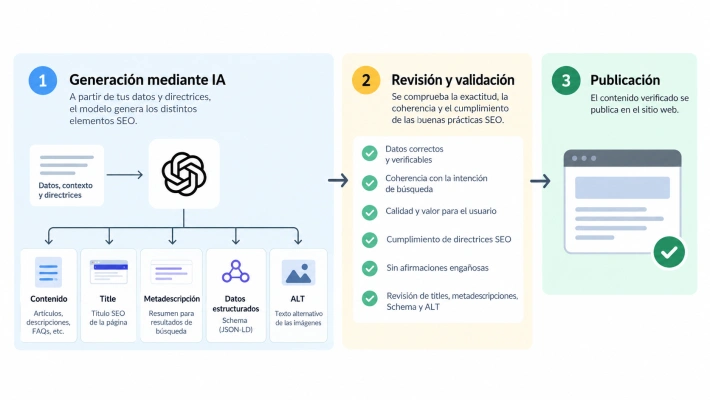
However, there is a detail that makes the update considerably more relevant for SEO: Google isn't referring only to the body of an article.
It also mentions <title> elements, meta descriptions, structured data and image alt texts.
These are precisely some of the elements we are starting to automate most easily.
The debate on whether Google detects AI is starting to lose importance
Over the last few years, a good part of the conversation about artificial intelligence and SEO has focused on one question: whether Google can determine that content was generated with AI.
It is an understandable question, but not necessarily the most useful one for making editorial decisions.
Google doesn't need to know which tool wrote a page to evaluate its quality. Its systems can analyze the end result, its relationship with the search intent, the value it adds, the consistency of the information, the originality of the content or the existence of mass-production patterns.
Google's own documentation on helpful, reliable, people-first content has long insisted that what matters is the final value for the user, not the specific method used during production.
That means a text written entirely by a person can be mediocre and content created with the help of artificial intelligence can be perfectly valid. The tool, on its own, doesn't determine quality.
For that reason, it is probably more useful to ask another question: if we completely ignored how a page was produced, would it still be a good result for the user?
That approach shifts the debate from the technology to the final product. And, from an SEO point of view, it is much more practical.
Google isn't giving a free pass to mass generation either
Accepting that the use of artificial intelligence isn't a problem in itself doesn't mean any production model is acceptable.
Within its spam policies, Google includes so-called scaled content abuse. The company refers to the creation of large numbers of pages intended mainly to manipulate rankings and that add little or no value for the user.
Among the examples it expressly lists is the use of generative artificial intelligence tools to produce many pages without adding extra value.
The nuance is important. Generating twenty thousand pages isn't automatically a violation. The problem appears when those pages exist fundamentally to occupy search results and not to solve a real need.
Scale, therefore, isn't the problem in itself. It is when it is combined with lack of value and with a strategy based only on increasing the indexable inventory.
This isn't exclusive to artificial intelligence either. Programmatic generation techniques, badly designed templates and low-quality human production can cause exactly the same result. AI simply lets you get to that result much faster.
Review now takes on a different importance
The main practical consequence of the update is that review stops being a generic recommendation and starts to become a fundamental part of the process.
Imagine an ecommerce site with tens of thousands of products. We have a structured database with attributes, prices, availability, categories and features. From that data we can use a generative model to produce descriptions, SEO titles, meta descriptions, frequently asked questions, alt texts and structured data.
From the operational point of view, the system can be extraordinarily efficient. It reduces time, maintains a certain consistency and lets you work with volumes that would be unfeasible through manual writing.
The problem appears when the process ends directly in publication.
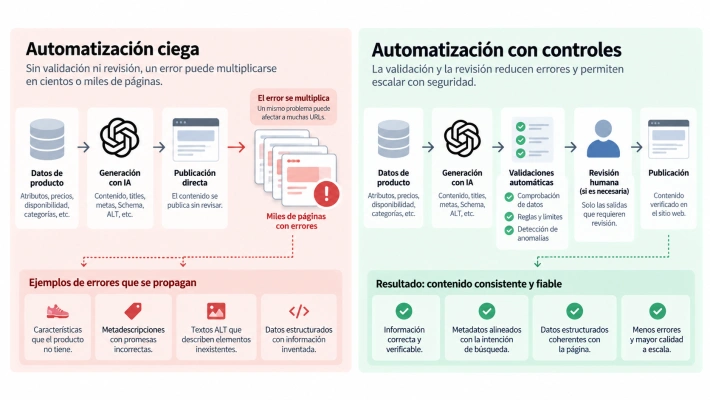
If the model interprets an attribute incorrectly, the error no longer affects just one page. It can spread across hundreds or thousands of URLs. A non-existent feature can end up incorporated into several listings. A meta description can promise something the product doesn't offer. An ALT text can describe elements that don't appear in the image. A block of structured data can include an incorrect property and reproduce it systematically.
Automation doesn't eliminate error. It increases its capacity to spread.
Metadata deserves more attention than we usually give it
One of the most interesting points of the new documentation is that Google explicitly mentions elements such as titles and meta descriptions.
Most of the conversation about AI and SEO has focused on generating articles and descriptions. However, metadata is probably one of the first areas where many companies start to automate.
Suppose we have eight thousand category pages and decide to generate their titles with a model. The system can produce eight thousand grammatically correct titles in a matter of minutes. From a technical point of view, the job is done.
From an SEO point of view, not necessarily.
There can be excessively repetitive structures, titles too similar to each other, commercial claims that can't be justified or differences in intent that the system isn't interpreting correctly. Cannibalization problems or a progressive loss of differentiation between pages can also appear.
The linguistic quality of a sentence doesn't guarantee its quality as an SEO element.
Something similar happens with meta descriptions. They can be perfectly written and, at the same time, describe the page badly, exaggerate a feature or include an advantage that doesn't exist.
Google's update puts the focus precisely on that difference. Generating content that is formally correct isn't the same as producing information suited to a specific URL within a real architecture.
Structured data shows the difference between validating and verifying even better
Structured data offers an especially clear example of this problem.
A model can generate a JSON-LD block that is perfectly valid from the syntactic point of view. We can put it into a validation tool and get no technical error. That, however, doesn't prove the information is correct.
Google explains in its general structured data guidelines that markup must faithfully represent the visible content of the page and must not be misleading.
An AI can correctly generate a price, availability, rating or author property. The problem appears if the information used is incorrect, outdated or comes from another entity. If on top of that those expired data are used by AI Mode agents during a multi-day search, it ends up being Google that puts up the pizzeria's sign.
In that case, the code will be valid and the data will be wrong.
This point is important because many automation processes lean too heavily on technical validators. A tool can check that the format is correct. It can't confirm on its own that the content represents reality.

Reviewing doesn't mean manually reading thousands of pages
The obvious objection is that a manual page-by-page review is unfeasible in large-scale projects.
On a small blog, an editor can review each post before launching it. On an ecommerce site, a marketplace or a programmatic project with hundreds of thousands of URLs, that model stops making sense.
The solution isn't to give up automation, but to design it with control mechanisms.
If we work with a structured database, we can prevent the model from introducing attributes that don't exist in the original source. We can set rules to block certain terms or commercial claims.
We can compare the generated entities with our own data. We can detect abnormally similar titles, automatically review the Schema or identify pages whose content strays too far from the expected patterns.
We can also resort to sampling. If ten thousand pages are generated with the same logic, it isn't necessary to read them all to detect a systematic problem. A well-designed sample can reveal error patterns early enough to correct the process.
Human oversight, therefore, doesn't have to happen on each individual piece. It can happen on the system that generates them.
That change of approach is probably one of the most important aspects of automation applied to SEO.
Human in the loop doesn't mean going back to manual work
The expression "human in the loop" is frequently used to describe processes in which a person maintains some kind of oversight over the output of artificial intelligence. However, it is often interpreted too literally.
A person doesn't need to rewrite each text or manually check each generated element.
Their role can sit at another level.
They can decide which sources are authorized, which attributes the model can use, which rules must be met, which cases must be blocked and which deviations require intervention.
They can review samples, study recurring errors and modify the process when they detect a problematic pattern.
In that context, human work doesn't disappear. It changes nature.
We go from producing each element individually to designing, supervising and improving the system in charge of producing them.
How to bring this into a real SEO process
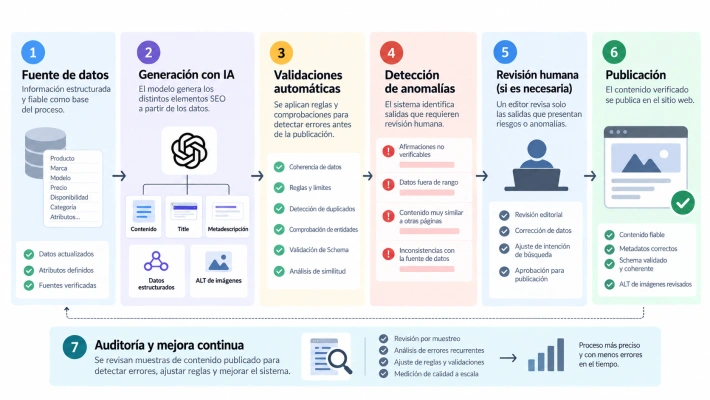
An AI-assisted generation system should control, at least, several levels.
The first is factual accuracy. Any objective fact should be verifiable against a reliable source. If we work with our own information, the system should prevent the AI from introducing attributes that don't exist in our database.
The second is fit with the search intent. Content can be correctly written and yet answer a need different from the one that corresponds to the URL.
This is especially relevant when we use the same template to produce large sets of pages.
The third is added value. Google's documentation on helpful, people-first content insists that content should exist because it is useful to the user, not simply because there is an opportunity to capture traffic.
Artificial intelligence drastically reduces the cost of generating new pages. Precisely for that reason, the question of whether a URL deserves to exist becomes more important than before.
Metadata also needs to be reviewed as a set, not just individually. Titles and meta descriptions should be analyzed in relation to other pages on the site, to the search intent and to the overall architecture.
Structured data requires a check against the visible information. The alt text must describe the real image and not a probable interpretation built from the context.
Finally, each project should decide which types of content can be published automatically and which require additional validation.
Not all errors have the same cost. Nor does all content need the same level of control.
We can also automate part of the review
A logical consequence of all the above is that the review itself can be partially automated.
We can use programmatic rules to detect inconsistencies between the output and the original source. We can compare entities, identify out-of-range values, look for anomalies within a batch or measure similarity between pages.
We can also use a second model to evaluate the output of the first, as long as that process has clear rules and doesn't simply become another layer of uncontrolled generation.
The goal shouldn't be to introduce a symbolic human review into the flow. It should be to build a system capable of identifying when it needs intervention.
That approach lets us keep the efficiency of automation without giving up editorial control.
What Google is really saying
The October 1 update doesn't radically change the rules of SEO.
Google continues to acknowledge in its documentation on generative AI that these tools can be useful for researching, organizing information and helping with content creation.
At the same time, its policies against scaled content abuse make clear that mass production of pages without added value can become a problem.
Both ideas are perfectly compatible.
We can use artificial intelligence. We can automate processes. We can work at scale.
What changes is responsibility for the production system.
As generating content becomes cheaper and faster, value shifts to other tasks: defining what deserves to be produced, controlling quality, verifying data and deciding when an output is good enough to be published.
To finish your coffee
Artificial intelligence is drastically reducing the cost of producing content and many SEO elements. That opens obvious opportunities for ecommerce, media, marketplaces and programmatic projects.
It also forces us to rethink quality control.
When generating stops being the hard part, reviewing, validating and deciding become more important.
Google's update points precisely in that direction. It doesn't set human content against AI-generated content. Nor does it propose abandoning automation.
What it demands is something quite a bit more reasonable: that the use of artificial intelligence be part of an editorial process capable of checking accuracy, detecting errors and keeping responsibility for what is finally published.
Technology already lets us produce more.
The professional challenge is building systems capable of doing it well.