Backlinks: what they are and how to check yours
Translated from the Spanish original. Leer en español

Some links make you feel important. Someone outside cites your site, and suddenly your page is no longer just the one you built by yourself. Google knows that. That is why some people try to buy that feeling by the pound, and why it pays to know which links count and which ones are just noise.
A backlink is a link from another website to yours. Google may read it as a recommendation, but not all of them add up, and buying them to rank higher goes against its spam policies. What you can do today is check who links to you, for free, in Search Console.
What is a backlink and what is it for?
According to the Search Console help, a backlink is a link on a page of another site that points to a page of yours. It is the link back, hence the name.

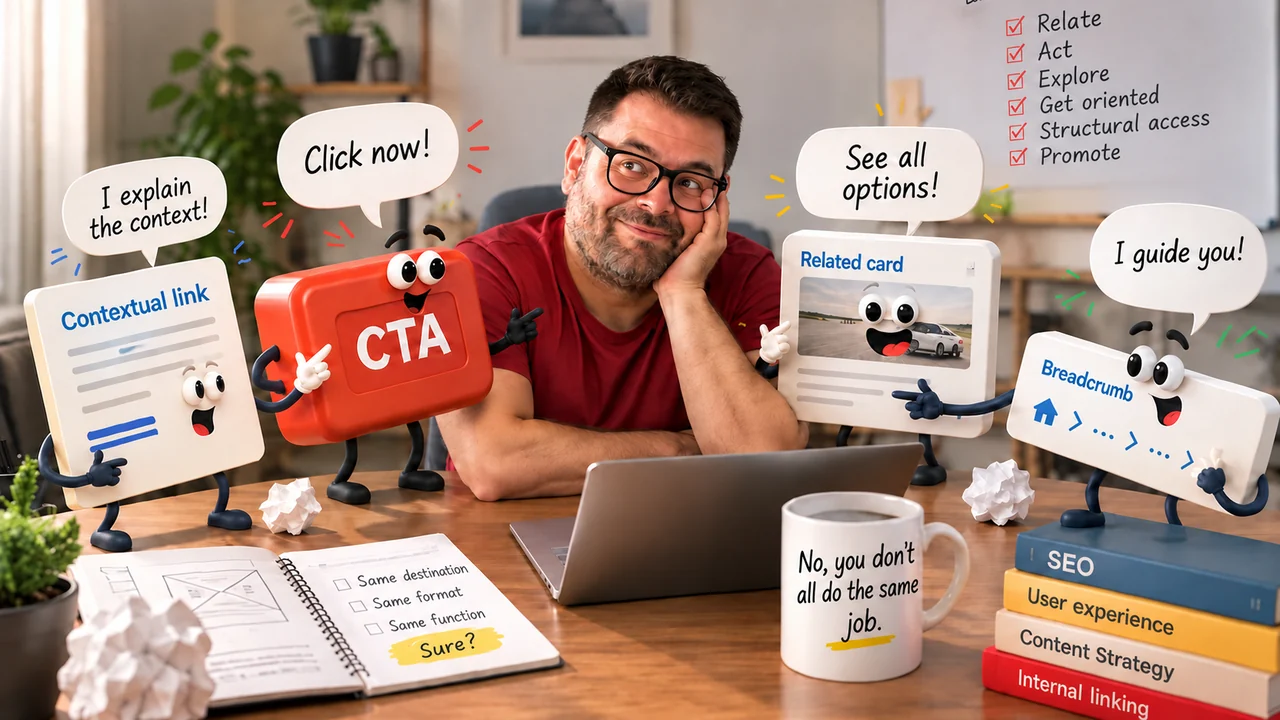
It is not the same as an internal link. You place the internal link yourself, between pages of your own site, to guide the reader and Google, and I cover that in internal linking: knowing where you link is not enough. Someone else places the backlink. And that is the point: nobody decides it for you.
What it is for, without selling smoke: it helps people reach your site from wherever they cite you, and it is one of the things Google watches because it can be manipulated. If it could not be manipulated, it would not have a whole section in Google's spam policies.
What makes a backlink worth having?
There is no magic number here. There is common sense, and you notice it when you apply it to a specific link: would that person have placed it if I had not asked?
| What we look at | Usually worth it | Usually noise |
|---|---|---|
| The linking site | Real, with its own content and readers | Created only to place links |
| Where the link sits | Inside a text about your topic | In the footer of thousands of sites |
| The link text | Natural, as a person would write it | The exact keyword repeated in every link |
| The surroundings | A topic close to yours | A low-quality directory or a widget with hidden links |
If you cannot see all the columns, scroll the table sideways.
This table is my reading of the link spam examples Google gives, not an official list.
Can you buy or swap backlinks?
If you do it to rank higher, no. Google's spam policies explicitly name buying or selling links for ranking purposes, exchanging them for goods or services, and excessive link swaps of the "link to me and I'll link to you" kind. Even sending a product in exchange for someone writing about it with a link is on the list.

An important nuance: Google acknowledges that buying and selling links is a normal part of advertising and sponsorship. It is not a violation if they are qualified with rel="nofollow" or rel="sponsored". For comments and forums, it recommends rel="ugc". And those attributes, Google says, mean the link is generally not followed, although the linked page can still be discovered another way, such as a sitemap. How one of them works in practice is in the nofollow link on Spotify.
How do you check your backlinks for free?
With the Search Console links report. You open it inside your property, under Links, and it shows the sites that link to you most, your most linked pages and the texts used to link to you. If you have not set it up yet, start with Search Console from scratch.

Three limits that save you from surprises, all from Google's own help:
- It is not a complete list: it is a sample of links, and some URLs may be left out.
- It groups by root domain: example.com, m.example.com and example.com/shop/ count together.
- Tables are cut at 1,000 rows, so on large sites you will only see part of it.
How do you get backlinks without buying them?
This part is less magic and more work. But it is the part that lasts.
- Publish something worth citing. That is what link baiting is about: content designed so others want to link to it.
- Take care of the places where your business should already appear: your Google profile, serious industry directories and local associations. If your business is local, see SEO in Castellón and the local SEO audit.
- Work with people who already talk about your field: local media, suppliers, clients, events. A link that comes out of a real relationship is the kind you never have to explain.
5-minute checklist to review your links
- Go into Search Console and open the links report.
- Look at the sites that link to you most. Do you know them? Do they make sense for your business?
- Look at your most linked pages. Is it the one you expected, or one you had forgotten?
- Look at the link texts. Do they sound like people or like a repeated keyword?
- Note down anything odd, but do not touch anything yet.
Frequently asked questions about backlinks
How many backlinks do I need? Google gives no figure, and neither do I. It depends on your sector and who competes with you. It is better to look at who links to you than to count links.
Is a nofollow link good for anything? For Google, links with nofollow, sponsored or ugc are generally not followed. Even so, a person can click it and reach your site, and that does not depend on any attribute.
What is a toxic link, and do I have to disavow it? Almost certainly not. Google says that in most cases it knows which links to trust, and that the disavow tool is advanced and should be used with care. It only recommends it if you have a lot of spammy or low-quality links and they have caused, or are likely to cause, a manual action.
What if I have bought links? Google recommends removing as many as you can first. If that is not possible, that is when disavowing comes in.
If you want someone to review your link profile and tell you what to do first, you can hire an SEO consultant.
Tomorrow, another Desayuno SEO. I already have the next topic: 301 redirects, what they are and when to use them. In Spain it is searched around 900 times a month, according to Semrush. If you change URLs, it matters to you.