How to turn Search Console impressions into more clicks
Translated from the Spanish original. Leer en español
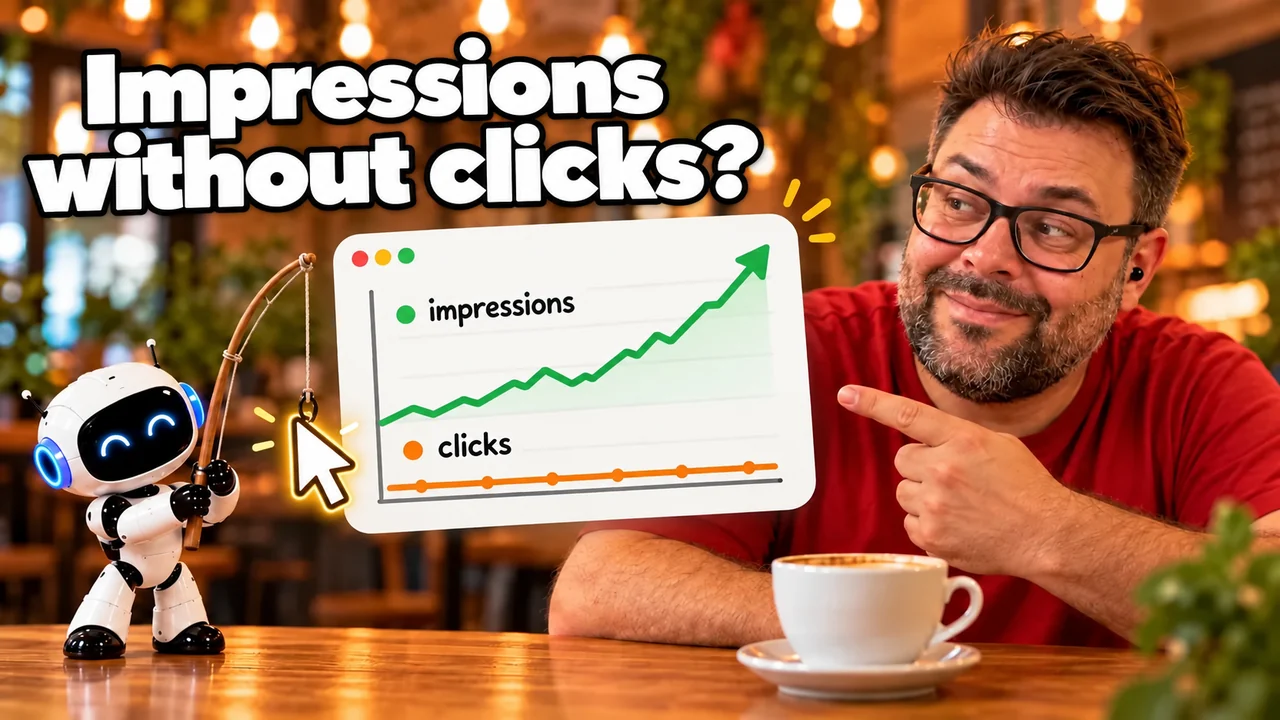
You open Search Console on a Monday morning and see a curve going up: impressions through the roof. Next to it, the other curve, the clicks one, flat or going down. It is one of the most frustrating situations, because Google is seeing you and people still don't come in.
Short answer. Turn on the four metrics of the Performance report (clicks, impressions, CTR and average position) and compare two periods. If the average position holds and CTR falls, the problem is in your snippet or in the results page, and that can be worked on. If the position falls, the diagnosis is different. In today's edition I walk you through that diagnosis step by step and through the improvements that bring the most clicks back.
In the previous edition we saw what to ask before hiring an SEO consultant. Today we go down to the report that anyone working on rankings opens most often, and of which many people only look at two numbers.
Why do impressions go up but not clicks?
Impressions count how many times a link to your website appears in the results, and the exact way of counting them depends on the type of result, as the report's official documentation details. Clicks count real visits. When the first figure grows and the second doesn't, one of these things is usually happening.
The most common: Google shows you for more queries, but many are long tail where you appear in low positions. The average CTR gets diluted, even if your main queries stay the same. Another frequent cause is that the results page has changed: more blocks, more direct answers, more visual competition before the first organic link. We talked about this effect in the article on AI Overviews, and the check of what is really above you is in Are you third on Google, really?.
It can also happen that your position holds but your snippet has stopped catching attention: a truncated title, a description that promises nothing, or a competitor that has improved theirs while you were looking at the curve.
What do you look at first in the Performance report?
Open the Performance report and turn on the four metrics: total clicks, total impressions, average CTR and average position. The report's official documentation explains each metric and how to filter by query, page, country and device.
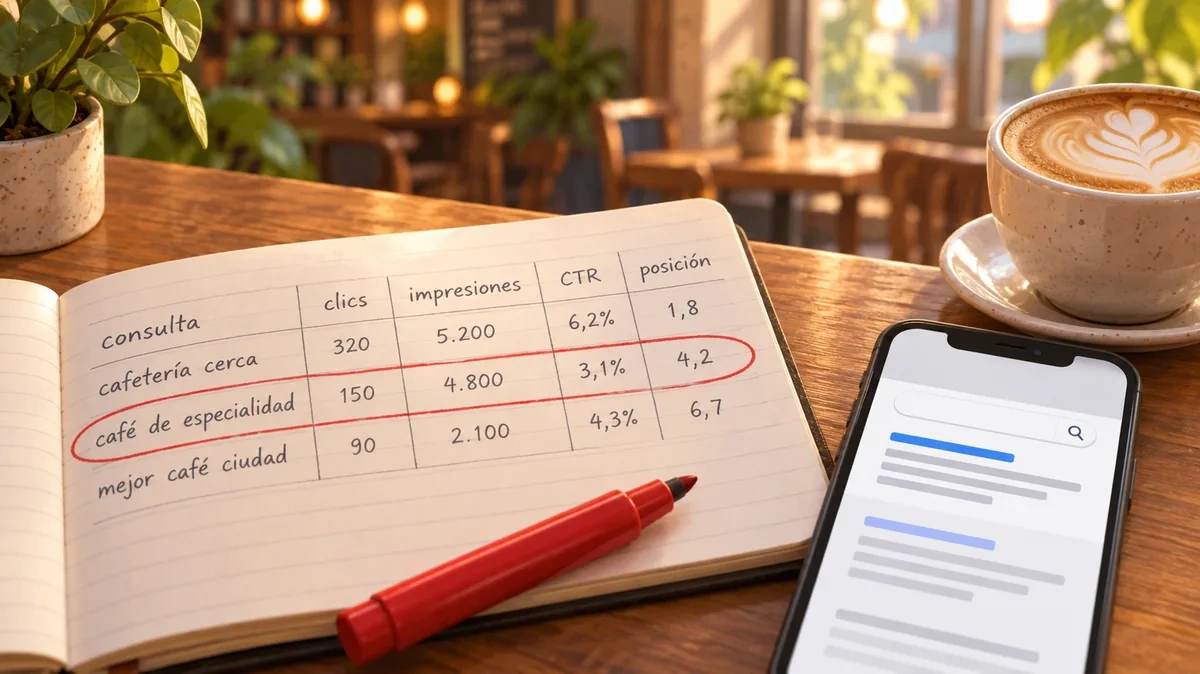
Then compare periods: the last four weeks against the previous four. Go down to the queries table and sort it by impressions. The answer is almost always there. Look at the queries that give you the most impressions and check their CTR and average position, one by one.
If you have the Search Console from scratch guide at hand, this is step three of that walkthrough. What we do today is go deeper into it: knowing what each metric looks at isn't enough, you have to cross them.
How do you know if the problem is your snippet or the SERP?
The test is to cross three columns per query: impressions, CTR and average position, compared between the two periods. Before drawing conclusions, segment: filter by query and by page, and look at country and device separately. The average position is an average, and it can hide that one query goes up while another goes down.
With the data segmented, these are the clues:
- Stable position, stable or rising impressions and falling CTR on the same query: the user sees you and doesn't choose you. Suspect the snippet or the SERP.
- Falling position: suspect relevance or competition, not the snippet. CTR falls because you are lower down.
- Stable position and CTR with fewer impressions: possible seasonality or a query that is cooling off. Compare it with the same period of the previous year before dismissing it.
None of the three is an automatic verdict: they are clues that get confirmed by looking at the specific search.
When the verdict is "they see you and don't choose you", open the specific search in an incognito window and look at the results page with fresh eyes. What is above your result? Does your title show in full or cut off? Does it say something worth clicking? No tool replaces that manual reading of the SERP.
How do you write titles and descriptions that win the click?
The title is your headline on Google's newsstand. It competes with all the results the user sees on that page, and the decision is made in seconds. Three things that work: the keyword toward the beginning, a concrete promise of what the reader gets and a format that reads at a glance (a number, a question, a "how to").

Keep in mind that Google can rewrite your title if it thinks another text on the page describes the content better. It explains this in its documentation on title links, and I talked about that specific annoyance in Google shows a title that is not the one I wrote. A good title doesn't guarantee it will be shown as is, but a careless title gives Google reasons to find another one.
The meta description doesn't rank, but it sells. It is your value proposition in two lines: what problem the page solves and for whom. In its documentation on snippets, Google reminds us that it can show another text if it considers it more useful for the specific search, so it is worth having a description for each page designed for its main query.
For lengths, don't count characters by hand: run the title and the description through the SEO character counter (in Spanish) and look at the traffic light and the preview before publishing the change.
What do you do with the queries between positions 3 and 10?
They are your quarry of clicks with the best effort-to-result ratio. A page hovering around those positions already has the hard part: Google considers it relevant for the query. Improving what it already has can help win places and, with them, clicks. There is no guaranteed multiplier, and Google needs to reprocess the page for the changes to show in the report.
The work there is finishing work: improve the title of that URL, reinforce the answer it gives in its first paragraph, add a section that covers the variant of the query you are not answering and point internal links with descriptive anchors. We talked about that in Internal linking: knowing where you link is not enough.
My criteria: I sort those queries by impressions and start with the first three. It is better to move three URLs with real demand than to go over twenty that nobody searches.
When is the problem the intent and not the snippet?
Sometimes the diagnosis hurts: you rank for a query whose intent is not the one your page solves. Google shows you, the user reads your title, senses it is not what they are looking for and moves on. Low CTR with a good position and a reasonable snippet is usually this.
The check is the same manual reading of the SERP. If the ten results around you are of another type (all comparisons and you a guide, all stores and you an article), the intent is against you. You have two ways out: adapt the page to the real intent or create the missing content and let each URL go after its own query. To decide it with data, the foundation is in the article on keyword analysis.
If after crossing this data you prefer a second reading, it is exactly the type of analysis I do in an SEO audit: query by query, what holds back the click and what to touch first.
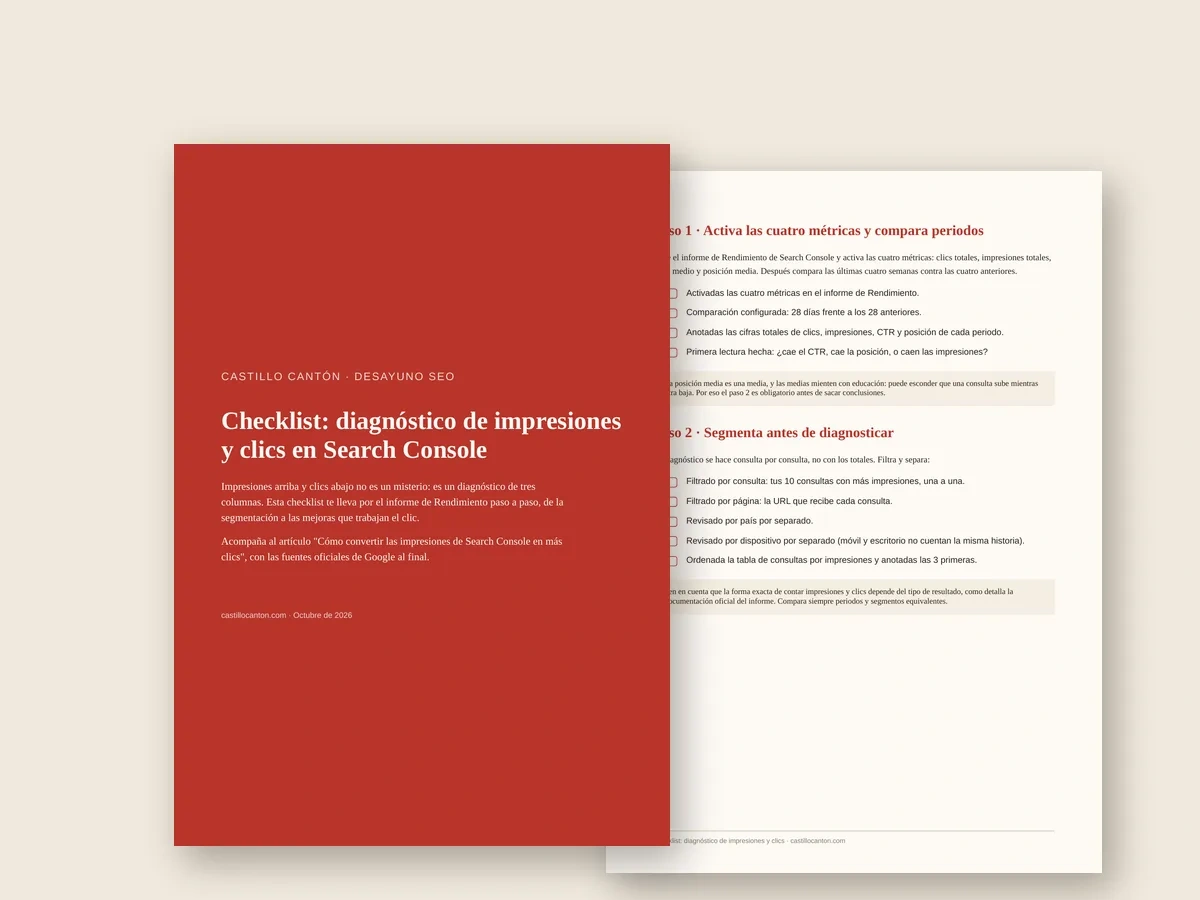
To organize this diagnosis I have prepared a printable checklist: the metrics to turn on, the segmentation, the clues per query, the snippet review and the quarry of positions 3 to 10, with a log sheet at the end. Download the impressions and clicks checklist (in Spanish, sent by email).
Frequently asked questions
Is there a good CTR to use as a reference?
There is no universal figure that works. CTR depends on position, on the type of query and on what Google shows in that specific SERP. The useful reference is your own: compare each query against itself between periods, not against internet averages.
Can I change the title every week until I find the right one?
You can, but you lose the measurement. The report takes time to reflect changes, so it is worth leaving a margin of weeks before evaluating. Touch one thing, note the date and wait before touching the next; if you change every few days, you won't know what moved the needle.
What if Google shows a different title from mine?
It is common and has a partial fix: strengthen the consistency between the title, the H1 and the page content. The detail and the official reasons are in the article dedicated to the titles that Google rewrites.
To finish your coffee
Impressions up and clicks down is not a mystery, it is a three-column diagnosis: position, CTR and impressions per query. If they see you and don't choose you, work on the snippet and look at the SERP with fresh eyes. If the position falls or the intent doesn't fit, the work is on the content.
Tomorrow we continue with another decision that is made before writing a single line: how to choose keywords for a local business. They are not the same as those of a national ecommerce store, and the difference starts with how you measure them.
Sources
- "Performance" report (Search results): introduction and basic setup, Search Console Help.
- Influencing your title links in Google Search, Google Search Central documentation.
- How to write meta descriptions, Google Search Central documentation.
Accessed on October 27, 2026.